From the Gilded Age Mansion to the Public Museum; the French Period Room in the United States;
The French period room in America originated in the mansions of the Gilded Age. French paneling and furniture became an essential element of the grand house in New York, Newport, or San Francisco in the last decade of the nineteenth century and up to 1920, reflecting the taste and power of the owners. Although we are more familiar with these French paneled rooms in the American museum today, their origins are often due to the barons of the Gilded Age. Several of the period rooms in The Wrightsman Rooms at the Metropolitan Museum of Art, New York, the J. PAUL Getty Museum in Los Angeles, and in San Francisco at the Legion of Honor originated in the private mansions of the very rich Americans in the early years of the twentieth century.
Authentic French paneling, or boiseries, were first introduced into the Vanderbilt mansion, the Breakers, at Newport in the 1890s, while others were also included as part of the furnishing of the elaborate new mansions being built on Fifth Avenue in New York in the succeeding decades. The salon from the Hotel D’Orsay, Faubourg Saint-Germain, Paris, was bought in 1904 by Senator William Andrews Clark for the enormous and rather overwhelming mansion that he built on Fifth Avenue.1 Completed in 1908, this massive structure only survived for less than a generation, giving way to a rapidly changing world in the 1920s and 1930s. By 1940 many of these great houses had all but disappeared from the New York cityscape. Senator Clark’s Salon Dore was given to the Corcoran Museum in Washington DC in 1928, where it survives today, much altered in form, but still reflecting the grand aspects of this fine French interior dating from 1770.2 In the third quarter of the nineteenth century French taste in architecture and decoration was already well known in the guise of the Second Empire style. Mansions with tall mansard roofs and lavishly gilded interiors of more contemporary French style were found all over the United States, but only later in the century did Americans discover the charms of the eighteenth-century Louis styles which could be freely employed as markers for taste and refinement. Architects such as Richard Morris Hunt who were trained at the Ecole des Beaux Arts in Paris set to work creating adaptations of the Grand Trianon, and the Petit Trianon, as well as major eighteenth century chateaux of France for America’s Gilded Age.
A whole industry grew up around supplying French eighteenth-century style architecture, interiors and decoration for Americans. The Parisian decorator and cabinet maker Jules Allard moved his business to New York in 1885. He supplied the lavish interiors for Marble House that was built from 1888 for William K. Vanderbilt, whose wife famously used this background to launch her daughter Consuelo as the future Duchess of Marlborough. He was swiftly followed by Lucien Alavoine in 1893, and the two firms were to become the mainstays of French eighteenth-century style interiors many of which incorporated the paneling exported from Paris due to the demolitions of Haussmann from the 1860s onwards. The Parisian dealer in paneling, Carlhian (1867-1975) was another major figure supplying boiseries for these homes, and it was this dealer who sold three rooms to Mrs. Carolan in 1912 Carlhian also supplied several interiors for Mrs. Hamilton Rice’s New York mansion, including a room inspired by the Chateau de Louveciennes, and a Louis XV salon which were later put on display in the Museum in Philadelphia in the 1930s. These would be among the first and finest French rooms to be shown in an American museum. Another figure who was closely connected with Gilded Age clients in supplying works of art as well as paneling was the antique dealer Joseph Duveen. His dealings with the paneling from the Salon Dore of the Hotel de La Tremoille, then thought to come from the Hotel Crillon on the Place de la Concorde, show the progression of panelings from private mansion to public museum. Originally installed in the huge Otto Kahn mansion at 91st and Fifth Avenue in 1916, Duveen bought the paneling in 1934 after Kahn died from his widow. Duveen then used this paneling as a background for displaying his French furniture in his premises further down Fifth Avenue. In the early 1950s the firm sold the paneling to Richard Rheem for his mansion La Dolphine in Hillsborough to panel his new ballroom. However, within a very few years Mr. Rheem gave the paneling to the Legion of Honor museum in 1959 where it has been redisplayed after a recent renovation.3
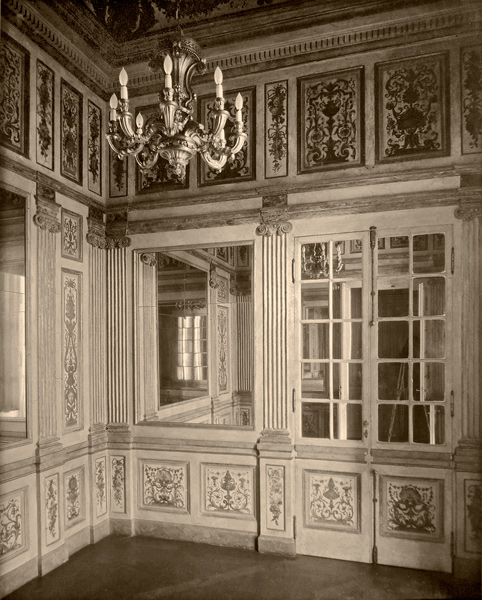
At the Fine Arts Museums of San Francisco period rooms were an important feature of display in the post war era. The old De Young included some nineteen rooms, or architectural features, by the 1980s, including a series of rooms from Dijon given by J. Pierpont Morgan to the Metropolitan Museum in New York. But as with the Gilded Age mansions, taste shifted rapidly and today there are no paneled or period rooms at the new De Young. At the Legion of Honor, however, three French period rooms remain on view, and are treasured aspects of the museum. They include the small room sold by Carlhian for the Carolands in 1912. Only briefly installed in the Carolands, this finely-painted room was given to the Legion of Honor in the 1950s. As it is now recognized that some of the panels painted with arabesques were created in the 1680s rather than the early seventeenth century, it is now installed as a Louis XIV room. It will be the subject of a renovation in the near future. This room is one of the finest examples of French paneling sent the United States in the early twentieth century as furnishing for one of America’s greatest Gilded Age mansions, Carolands, and today is shown in one of the great public museums in the United States.
–Martin Chapman Curator in Charge of European Decorative Arts and Sculpture
1 The house is featured extensively in the recent book Empty Mansions: The Mysterious Life of Huguette Clark and the Spending of a Great American Fortune by Bill Dedman and Paul Clark Newell, Jr., 2013
2 Dare Myers Hartwell, The Salon Doré; The Corcoran Gallery of Art, Washington D.C. 1998
3 Martin Chapman, The Salon Dore from the Hotel de La Tremoille, Fine Arts Museums of San Francisco, 2014.