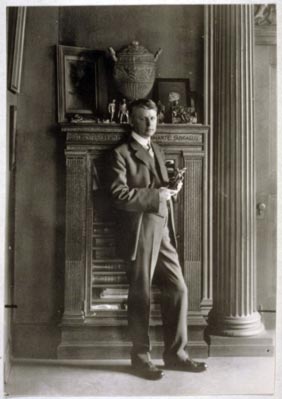
Photo: Environmental Design Archives College of Environmental Design,UC Berkeley.
Willis Polk’s early career included work with McKim, Mead & White, as well as Bernard Maybeck. Polk also worked with Daniel Burnham in Chicago, and then moved to San Francisco to establish and direct Burnham’s San Francisco office. Before long, Polk started his own firm and spent many years designing highly regarded California commercial and residential architecture.
In 1901, Polk went on a tour of Europe and Chicago. In Chicago, he met prominent architect Daniel Burnham. From 1903 to 1913, Polk was the West Coast representative of D.H. Burnham & Company. Polk designed several of his most notable structures while associated with the firm, including the Merchants Exchange Building, the tallest building in San Francisco upon its completion in 1903. The 1906 San Francisco earthquake opened up numerous opportunities for Polk to design Burnham structures. He was a member of Mayor Eugene Schmitz’s Committee of Fifty leaders who undertook ambitious plans to rebuild a world-class city. Polk was tasked with convincing city officials to adopt Burnham’s 1909 Plan of San Francisco.
By 1910, Willis Polk was recognized as one of the most influential architects and urban planners in the city. Polk was again credited for designing the tallest building in San Francisco when his Hobart Building was completed in 1914. In 1915, Polk was appointed the chair of the architectural planning committee for the Panama–Pacific International Exposition. When the exposition concluded, Polk led the effort to preserve Bernard Maybeck’s Palace of Fine Arts. One of Polk’s most influential commissions came in 1916, when he was tasked to design the Hallidie Building. Its glass curtain facade was a precursor to modern skyscraper development. It has been argued to the be the most important building in San Francisco. Polk was a versatile architect, with particular skill in combining classical styles with environmental harmony. He was regarded for his elegant residential work, mainly in mansions and estates, in the Georgian Revival style for wealthy and prominent San Francisco residents.